



Shipping guide
How to pack a parcel for courier and freight
Updated October 14, 2026
Good packing does two jobs: it protects your items in transit and helps them clear customs without fuss. It also affects the price, because couriers charge partly on box size. Here is how to pack a parcel that arrives safely and does not cost more than it needs to.
Choose the right box
Start with a sturdy box that suits the weight and contents. A double-walled carton is worth it for anything heavy or fragile, while a single-wall box is fine for light, soft items. Use the smallest box that fits, because couriers price large parcels on their size as well as their weight, so an oversized box with lots of empty space costs more.
Reuse boxes only if they are still strong and you remove or cover old labels and barcodes, which can confuse sorting machines. If in doubt, a new box is cheap insurance for the contents inside.
- Match the box strength to the weight (double-wall for heavy or fragile)
- Use the smallest box that fits to keep the price down
- Remove or cover old labels and barcodes on reused boxes
Cushion the contents
Wrap each item and fill every gap so nothing shifts when the box is moved or dropped. Bubble wrap, air pillows, foam or even scrunched paper all work; the goal is that when you gently shake the sealed box, nothing rattles.
Keep contents away from the walls and corners of the box, which take the most impact. For heavier items, cushion the base well so they do not press through the bottom.
- Wrap items individually and fill all void space
- Keep contents away from box walls and corners
- Nothing should move or rattle when you shake the box
Pack fragile and awkward items
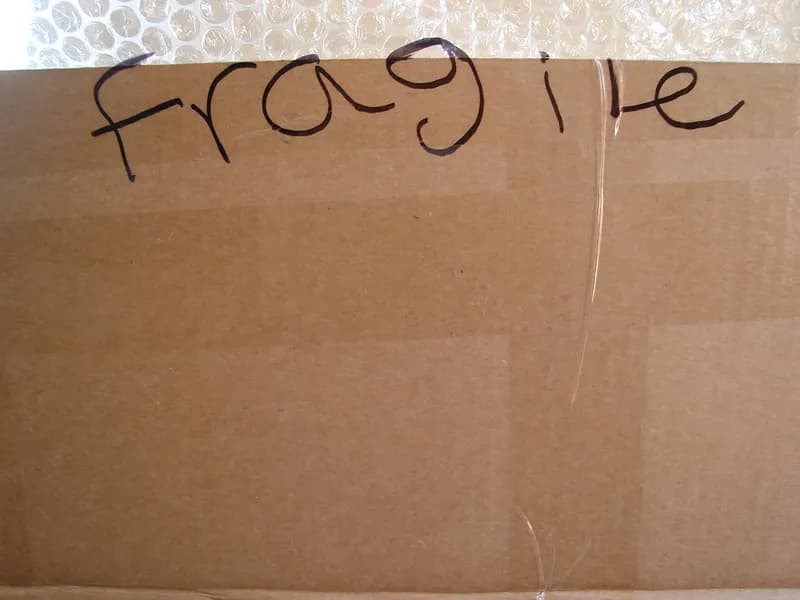
Fragile items such as glass, ceramics and electronics need extra care. Wrap them thickly, separate them from each other so they cannot knock together, and mark the box as fragile so it is handled with care. For very delicate pieces, a box-in-box method, with cushioning between the two boxes, gives the best protection.
For liquids, seal lids with tape and bag each container in case of leaks. Batteries, including lithium batteries, are restricted, and so are devices that contain them; they can travel only under the carrier's and destination country's rules, so tell us about them in advance.
- Wrap fragile items thickly and separate them
- Use a box-in-box for very delicate pieces
- Bag liquids; tell us about any batteries or battery-powered devices
Seal and label it clearly
Seal every opening with strong packing tape using the H-taping method, where you tape the centre seam and both edges. Masking tape, cellophane tape and string are not enough and can come apart in transit.
Write the full delivery address and a working phone number clearly, and remove any old addresses. A legible label with a contactable number is one of the simplest ways to avoid delivery delays, especially internationally.
- Seal all seams with strong tape (H-taping method)
- Write a full, legible address and a working phone number
- Remove or cover any old addresses or labels
Keep a content list for customs
For international parcels, keep an accurate list of what is inside and its value. This matches your customs declaration and helps the shipment clear quickly. Under-declaring value to save on duty usually backfires with delays or returns, so declare honestly.
If you are shipping to India or another country with a KYC or ID requirement, have that ready too. We prepare the paperwork and check it with you before the parcel ships.
Do's and don'ts of packing
Follow these simple tips to help your parcel arrive safely. Do use strong cardboard boxes, wrap fragile items securely, fill empty spaces with cushioning, seal all openings with strong tape, attach a clear shipping label, and check the weight and dimensions.
Don't use weak or damaged boxes, leave items loose inside, overfill or overload the box, use weak tape or loose wrapping, cover the label or barcode, or ship prohibited items. Proper packaging helps prevent damage, delays and additional shipping costs.
Let Smart Save help
If you would rather not guess, bring us your items and we will advise on the right box and packing, or check a parcel you have already packed. We offer door pickup across the GTA and handle the paperwork, so your shipment travels safely and clears customs smoothly.